Evelyn Del Rey is Moving Away Book Review
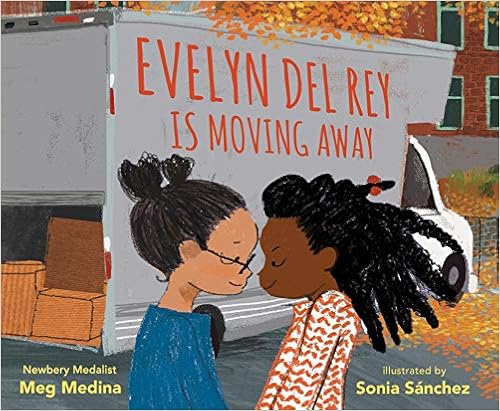
Evelyn Del Rey is Moving Away
Medina, Meg and Sonia Sanchez. EVELYN DEL REY IS MOVING AWAY. New York: Candlewick Press, 2020.
ISBN: 978-1536207040
ISBN: 978-1536207040
Evelyn Del Rey is a moving picture book that feels simple but leaves the reader with complex emotions. The story takes place in a single day (maybe even just the morning), but it manages to tell the entirety of a friendship that spans years before this day and into the future after this day. Daniela and Evelyn Del Rey are best friends who live in apartments across from each other (they can even string a can telephone between their bedrooms). They love to play hide and seek, talk to the neighbors, spin in circles, and use their imaginations. They do all of this on their last day together, because Evelyn Del Rey is moving away, No reasons are given for the move. The girls don’t speculate or cry. Instead, they spend their last morning doing what they’ve always done: spend time with each other in the ways they love best.
Evelyn Del Rey is Moving Away Book Trailer
Daniela
describes herself and Evelyn, “Our apartments are almost twins, just
like us” (p. 12). Then again, “We are mostly the same, just like our
apartments” (p. 14). For the two girls, the only important things to
them are their shared experiences: their secret handshake, their hiding
spot where they hide their “special finds,” their rituals, and their
playing. These are the things that make them “almost twins,” not their
physical traits. Daniela is illustrated as brown-skinned with brown hair
typical of a Latina. Evelyn Del Rey presents as Black, but speaks
Spanish as well as Daniela. We meet Evelyn’s mother, who is portrayed as
very dark-skinned Black. In the pictures, the sweet friends are
definitely not twins, but they know that the most important things that
make them twins is not on the outside; it’s the things they will “always
know by heart” (p. 29).
Author Meg Medina Interview
Sonia Sanchez’s illustrations are vibrant and moving. It is digital art, but it is evocative of crayon and colored pencil drawings that the girls themselves might have drawn for one another. In most of the book, the girls are drawn together. They are usually the focus of the page, but the reader sees them from afar, in context with whatever activity they are doing together. It is near the end of the book, when the reality of Evelyn actually leaving looms large, that we get close-ups of the girls. There is a particularly affecting close-up when the two girls seal their promise to “talk every day after school” and visit one another. They seal their promise with sparkly stickers on their cheeks (p. 23). My favorite picture is on pages 19-20. Sanchez separates the girls into different settings. Daniela is pictured bundled up in her autumn apartment, but Evelyn is shown in a sundress sitting in a palm tree. Without words, the reader knows that Evelyn Del Rey is moving very far away. It is a moving moment.
The theme of this book is that friendship transcends time. Medina shows, in one brief moment, a lifetime of friendship. The deep rituals and play and feelings that make up a friendship. The girls don’t dwell on the past or the terrible future of separation. Instead, they play and love each other as they always have and always will, even if they’re physically apart. The choice to portray young Daniela at the opening of the book and older Daniela at the closing is a small artistic choice that really cements the power and long-lastingness of friendship.
Friendship
is what you share with each other. That also transcends time. It is not
dependent on how a person looks, as aptly illustrated by Medina and
Sanchez. This is not an “Hispanic” story or a “Black” story. This is a
story about the universality of friendship, and Medina and Sanchez prove
this by having a Latina and a mixed-race girl as the main characters.
The reader is not fazed by the color of the characters’ skin. As a
reader, though, I was taken aback by the illustration of Evelyn’s
mother. She is drawn more darkly than I’ve seen in many, many books.
Even in books with Black main characters, they are drawn more
lighter-skinned. I enjoy this thoughtful inclusion by Medina and
Sanchez.
Programming Connection
After reading Evelyn Del Rey is Moving Away, we will discuss the picture on p. 19-20 which shows Daniela and Evelyn in different settings. We will discuss the importance of details in drawings that depict the setting for the reader. Students will research different geographic regions of the United States: the plains, the three different coasts, the mountains, etc… They will choose two different regions and draw one picture showcasing the detailed differences of the two, without words.
Programming Connection
After reading Evelyn Del Rey is Moving Away, we will discuss the picture on p. 19-20 which shows Daniela and Evelyn in different settings. We will discuss the importance of details in drawings that depict the setting for the reader. Students will research different geographic regions of the United States: the plains, the three different coasts, the mountains, etc… They will choose two different regions and draw one picture showcasing the detailed differences of the two, without words.


Comments
Post a Comment