Poet X Book Review
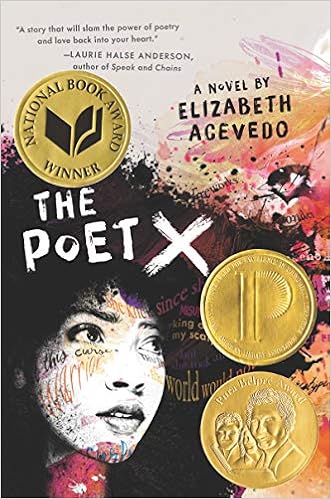
The Poet X
Acevedo, Elizabeth. THE POET X. New York: HarperCollins Publishers, 2018.
ISBN: 978-0-06-266280-4
"We're wild women, flinging verses at each other like grenades in a battlefield, a cacophony of violent poems" (p. 308).
The women from this quote are Xiomara Batista and her Mami. Xiomara struggles to find her place in her home and community, especially with her strictly religious mother, Mami, in Elizabeth Acevedo's award-winning book The Poet X. This lyrical coming of age novel is written in the first person: Xiomara's own poetry that reflects her rich inner life as she figures out who she is in a community of immigrants, children of immigrants, adults and boys who objectify her, and a religious community that often feels stifling. Xiomara write poetry for herself, rarely sharing her feelings with others. She lives in a tough world where she has to protect herself physically from bullies and boys (and often grown men) who feel believe they have the right to touch her, just because she has fully developed hips and breasts. Xiomara also fights to defend her Twin brother. Her body defines her in this world (even her mother thinks she is a potential harlot, not a girl, because of her body), and she works to find an identity for herself outside of this. She feels alone in this fight. No one defends her. Even her boy crush, Aman fails to defend her at a critical point in the novel. Her English teacher invites her to join a poetry club, and it is here that Xiomara finds people who welcome her as she is, and she finds people willing to stand by her side.
Elizabeth Acevedo discusses The Poet X
Set in the Harlem area of New York, Xiomara (X) is part of the heavily Hispanic community. Her world is specifically Dominican. The novel is rich with details from an immigrant/first-generation family and community. There is a feeling of being watched all the time. Sometimes X feels the strength that a close-knit community brings: a coming together in times of tragedy, a common language (the authentic Dominican slang that is richly woven into X's narrative), and a feeling of belonging. However, there are downsides to this closeness, and X feels it. When she has her first crush with Aman, a boy who doesn't objectify her like many of her classmates, X has to hide it. Her Mami will violently object (Mami does slap X a few times and force her to kneel on rice as punishments). Mami wanted to join a nunnery in the Dominican Republic, but her parents forced her to marry so she could go to the US. Her intense religious devotion combined with her upbringing with strict gender roles, causes Mami to think that X's normal interest in boys and sweet crush is a manifestation of promiscuity. When X lets Aman kiss her, she makes sure that it is far away from her community, because she knows that someone will see her and tell her mother. She didn't go far enough away. She is seen, and her mother finds out. There is an explosive confrontation. There are many explosive confrontations. As X says of herself and her mother, "We might be too much the same mirror" (p. 340). Both are strong-willed, passionate, and unable to communicate with each other. Mami's passion is religion. X's poetry and exploration. Mami sees X's questions about religion a rejection of her and the sacrifices she made for her daughter. X sees Mami's harsh inability (which reflects an older, religious immigrant viewpoint) to let X find her own way as a rejection of her daughter. They eventually, painfully, learn to talk with one another.
The theme of this novel is learning to stand up for yourself. Xiomara, as a second generation Dominican in a strict religious household, has had to fight for her identity. She faces the larger inequities of being Hispanic in a white world, but, more immediately, she faces inequities even in her own community. Her mother treats her Twin brother differently (better) because he is male. She faces constant sexual harassment because of her curvy figure. This is, sadly, an issue most girls face, but it is compounded in her Dominican community where "machismo" and strict gender roles make commenting on women's bodies commonplace. It is also compounded by an overly-zealous application of religious dogma: a women's worth is inherent on her virginal status, so any slight appearance of straying from this diminishes her worth. X also doesn't have the easy acceptance of religious faith that those around her do. Sometimes X literally fights against these strictures. Other times she shrinks herself to fit others' expectations. With all these odds stacked against her, X learns to stand up for who she is and how to exist (mostly) peacefully within her home and community.
This is all told with Elizabeth Acevedo's sparse but passionate poetry. As Xiomara says, "My poetry has become something I'm proud of. The way the words say what I mean, how they twist and turn language, how they connect with people, How they build community" (p. 287). Acevedo uses her poetry in this novel to connect the reader to Xiomara and her community. She uses pauses to emphasize deep reflection and Dominican slang to enhance emotional moments of resonance for X. I especially enjoy the poem that shows X's nervousness and internal monologue before her debut at the poetry slam (p. 353). Acevedo's use of colons and semi-colons to create the fluttering pauses of a nervous heartbeat is beautiful. You feel the anxiety and excitement as you read.
Elizabeth Acevedo original poem Hair
Programming Connection
Students will write their own poem with Ms. Galiano's first assignment (p. 39): Write about the most impactful day of your life. Students will participate in their own poetry slam in the library to share these poems.


Comments
Post a Comment