Julian is a Mermaid Book Review
Julian is a Mermaid
Love, Jessica. JULIAN IS A MERMAID. New York: Candlewick, 2018.
ISBN: 978-0763690458
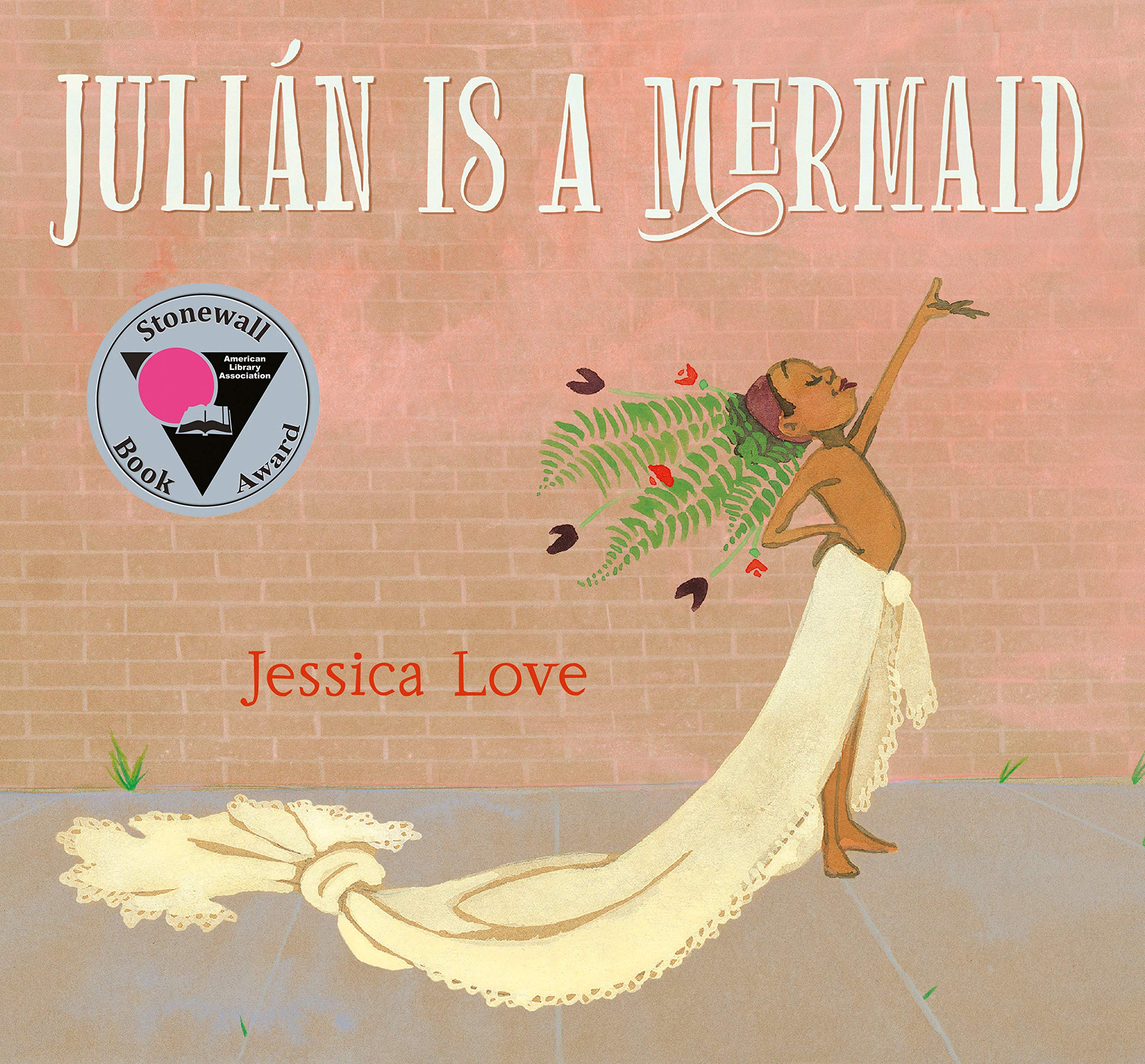
Author and illustrator Jessica Love has created a lovely story of acceptance and wonder through an illustrative filter of oceanic watercolor. Julian is a young, Afro-Latinx boy who, while traveling with his grandmother on the subway from her water aerobics class, sees three beautiful mermaids. Their awe-inspiring appearance in an ordinary, pedestrian setting sets Julian's imagination aflame and makes real his desire to be who he really is: a mermaid with flowing hair, surrounded by beauty.
Julian is a Mermaid Book Trailer
The reader is to understand, implied through the gentle illustrations and limited prose, that Julian is transgender or gender fluid, perhaps without even realizing it himself. He expresses this inner longing by wishing to be a mermaid. The mermaids on the subway are painted boldly by Love, with vibrant hair colors and mermaid suits that evoke the waters where they swim (p. 2). These bold colors are in contrast with the hazy watercolors in most of the rest of the book: an effect that creates the illusion of seeing images though the water. This is how Julian imagines himself transforming into a mermaid: a hazy dream-like longing. When he sees these mermaids in real life, their clear images help Julian take his unexpressed longings. While his grandmother is in the shower, Julian uses items from the house to turn himself in to the mermaid he is inside. In this physical transformation, as well as in his imaginings, Julian's eyelashes and hair lengthen, and he sheds his "boy" clothes. With these simple illustrations, Love implies to the reader that Julian wishes to be something other than male-presenting.
Love uses her illustrations to show the grandmother's wordless acceptance of Julian. When she comes out of the shower to see Julian dressed in a mermaid tale (skirt), a wig made of a flowing green plant with flowers attached to simulate flowing hair, and lipstick applied, Julian proudly stands before her a mermaid. For a moment, all Julian and the reader see is a slight frown on the grandmother's face. We both interpret it as denunciation, "Uh-oh," Julian says to himself, with his arm crossed protectively around his exposed middle (p. 22). Instead, though, her frown was of contemplation, as we see her give Julian a strand of pearls to complete his transformation. Her acceptance is sweet and without fanfare. Love shows this in another bold illustration, without the haziness of water and without words, as she takes his hand to go forth into public together (p. 26). She takes him to where all the mermaids are, cementing the theme of acceptance and helping others on their journey.
Representation Matters Interview
Besides the theme of transgender acceptance, there are other moments of everyday diversity. The mermaids on the subway are implied to be drag queens. Grandmother's water aerobics class is drawn in a diversity of body sizes and shades of Black. As Julian and his grandmother walk home from the subway, they walk through a city well-represented with Black and Latinx children and people. Like the grandmother's acceptance of Julian with little fanfare, the diversity presented in this book is ordinary and presented matter-of-factually. My favorite illustrations are the front and back illustrations which show Grandmother and her water aerobic friends. In the front illustration, they are in their different old-fashioned swimsuits. In the back illustration, these same women are portrayed as mermaids, with their mermaid "skin" the same colors and patterns of their swimsuits. It's a lovely bit of whimsy to end the story.
Programming Connection
Students will read the following interview excerpt with Jessica Love where she discusses her reasoning for writing this story with an Afro-Latinx transgender protagonist, even though she is a white, cishet woman.
Students will turn-and-talk, deciding if this explanation, as well as the story itself, makes it "okay" for her to write this story. Pairs will present their decisions and reasonings to the class, in a whole class discussion.


Comments
Post a Comment