Me, Moth Review
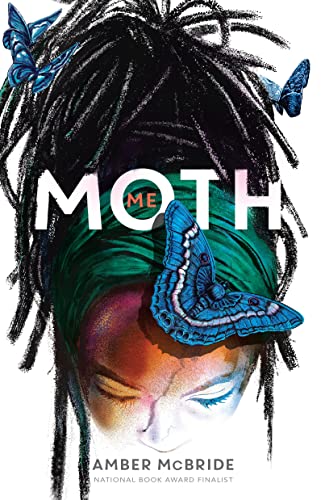
Me, Moth
by Amber McBride
Bibliography
McBride, A. (2021). Me, Moth. Feiwel and Friends.
ISBN 978-1-250-78037-9
Summary
Like a ballet, Me, Moth is perfomance art that carries the reader through explosions of movement, grace, passion, and stillness. Moth is a ballerina who no longer dances, a daughter who no longer has parents, a sister who no longer has a sibling. After a tragic car accident, "There was only enough prayer/ & blood for one of us to walk out" (4). Moth is the one who is left: into the care of her Aunt Jack to recover and recover her sense of self. Aunt Jack lives in Northern Virginia, and Moth has to suffer the indignities of racism in addition to her grief. "The white kids slip new names at the/ other Black kids like nooses each bus ride," and the bus driver does nothing (13). At her new school, she meets a Navajo boy named Sani who is living with his white mother, far from the Navajo reservation and his healer father. He plays music and notices Moth when no one else seems to. In fact, his friendship makes Moth, who had no more desire to dance, start moving her feet in ballet positions, "He taps his pencil slower/ & my feet point in my shoes./ I wrap my ankles around the legs of/ my chair,/ strangling my will to move, to/ sway, to dance—" (14). As their friendship grows, Moth and Sani decide to take a road trip. As all readers know, "A road trip is a thing that you go on/ & come back different" (76). This road trip changes everything for Moth and Sani. They learn who they are and what they can become. Amber McBride tells a breath-taking coming of age story, haunting with spirituality, where feelings dance, and the reader moves with Moth. McBride includes back matter where she credits people who helped her correctly articulate the Navajo creation myths used in the novel. She also discusses the origins of the Hoodoo that Moth's grandfather practiced. Hoodoo is a weaving of African spiritual traditions and Christianity that was used by enslaved people and spread with the Great Migration after Emancipation (244). This Hoodoo, or rootwork, is woven extensively throughout the novel, shaping the narrative as it shaped Moth herself.
Analysis
This novel is different. Being a novel in verse is already different from the usual teen fiction. However, from the first page, the reader feels smacked by otherness. This is deliberate, as Moth, herself, feels like the other. She is lonely in her grief, outside because of her race, and lonely within herself. Bereft of her family, Moth further exiles herself by not returning to her beloved ballet. Her grandfather once told her, "You dance like magic because/ you offer so much blood" (13). Moth has no more blood to give to dance, mostly because she thinks she didn't give enough, because she, alone, survived. In addition to this feeling of otherness, there is a melancholy that haunts the novel. Surprisingly, this does not alienate the reader. It is a relatable feeling, so rather than repel, it draws the reader in. McBride's choice of novel in verse is fitting for a character named Moth. As Moth tells us in Transverse Orientation, moths have "delicate wings,/ which sprinkle/ dust & death like whispered omens" (19). The poems, with their short stanzas, short lines, and carefully selected figurative language, mimic the movements of moths, flitting from subject to feeling to action in a delicate whisper. We learn in this poem, "It is not true that moths like light—/ that's a butterfly thing" (19). Moths fly straight by following the angle of the moon: known as "transverse orientation." With the invention of modern lights (first fire, then lanterns, finally electricity), moths mistake these for the moon, and are actually falling toward these false moons. They've lost their lodestones and their gravity, just as Moth has lost hers. McBride's most stunning simile is also its most horrific. Moth describes her family's car accident, "Two summers ago our car broke in half/ like a candy bar on the freeway & we all/ spilled/ onto the pavement as crumbled as sticky/ caramel-peanut filling" (4). Comparing the physical car wreck to a delicious candy bar taints all sweet things for the reader, as the accident taints all the good things Moth has left in her world. This motif is repeated 9 times throughout the novel. Even as Moth learns to love good things again, her grief will never subside. The motif is woven in the novel, as it is woven into her spirit.
Highlighted Poem
I chose this poem because I related to it the most. One of the beauties of this novel in verse is that while it is weirdly haunting, it is very relatable, even for people who have not suffered the effects of physical and emotional trauma, racism, or deep grief. I have felt like the other. I love to dance (even though I'm not good at it like Moth) and feel it deep in my bones when she proclaims, "for a moment I am full/ on movement" (135). I also love a road trip. I have a gift for convincing people to go with me on spontaneous road trips. My heart traveled with Sani and Moth as they traveled across the country from Virginia to New Mexico.
Four Corners
Arizona, Colorado, New Mexico & Utah
The only place in the United States
where four state lines kiss.
Like four barefoot girls
holding hands & circling
a campfire.
This entire region is a crossroads
dripping with magic—
the sandy dirt so vibrant with spirits,
it glitters in the sun.
It feels like the ground reaches
up to cradle the wheels of our car—
I think we might be flying.
The land remembers Sani,
Sani remembers the land.
Because the land is me, Moth.
He is right; the breeze
sings through the car
& plays with my hair.
I lived in New Mexico. It is beautiful and magical. You can feel it in the starkness of the desert. You can feel it in the tall mountains. You can feel it in the colors of the sun rising above them. The sun permeates all of your cells like magic. Like the magic of rootwork.
Use
Students will choose an insect to research. They will find little known facts and share them with their classmates. They will then use these facts and decide how they are similar to this insect, writing a concrete poem in the shape of their insect, using these comparisons.


Comments
Post a Comment